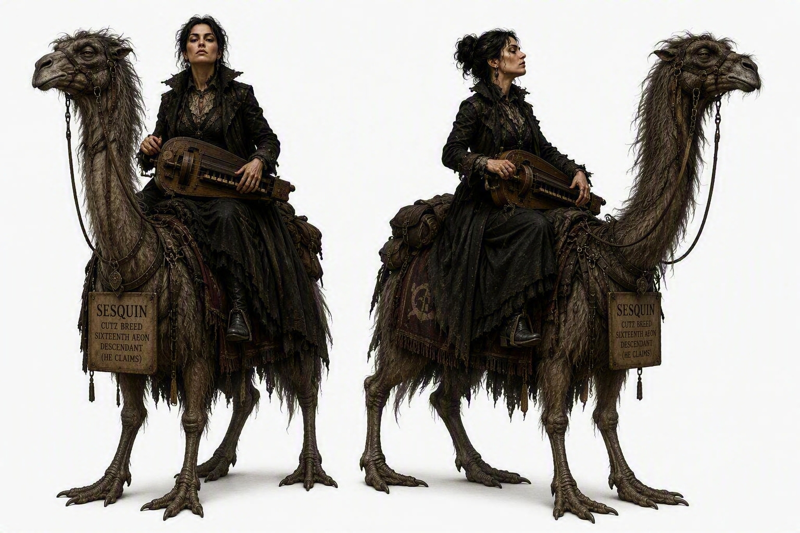
The Contralto of Cutz began as a character-design exercise and became a production system for making music in the world of Jack Vance’s The Dying Earth. The project’s central figure is Ossaline Threnn, a travelling singer, hurdy-gurdy player and former rat-catcher. Born Tibbet Snurl, she acquired her instrument as payment after clearing the manse of a dead thaumaturge. She then abandoned rat-catching, invented a grander name, and set out along the road with a failing contract, eleven terces and a collection of songs—some of which are also spells.
TL;DR - read the book and listen to the music.
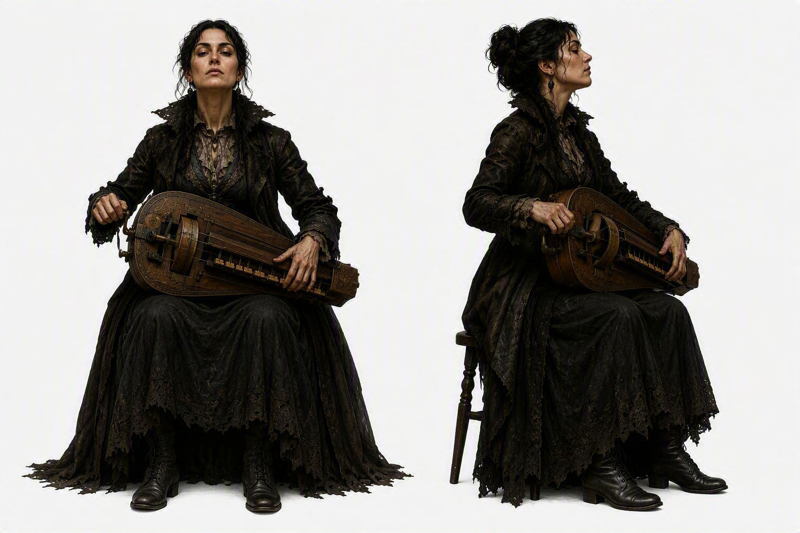
That backstory determined the music. Ossaline’s songs had to sound as though they could be performed by one woman in a roadside room, not by an anonymous fantasy orchestra. Her signature instrument became the hurdy-gurdy: a small wooden machine with a continuous drone, a buzzing bridge known as “the dog”, and enough mechanical noise to function as both accompaniment and percussion. The voice was specified as a low, husky contralto—warm, grainy, formal and slightly foreign, with the theatrical confidence of somebody who has taught herself courtliness.
The broader Dying Earth palette provided the setting: chamber instruments, modal melodies, elegant dissonance, old machinery and luminous strangeness. But Ossaline’s music deliberately rejects some of that refinement. There is no orchestral swell, glassy fantasy shimmer or expansive choir. Her sound is closer to a wheel, a voice, a bowed bass and a struck piece of iron. The world may be immense and mysterious; Ossaline is still standing in a room trying to get paid.
The first song, The Diminution of Ratteries, was designed as her origin story. Its narrative moves from the nine-day job in Kaspel Voy’s infested manse to the discovery of the hurdy-gurdy that changes her life. The chorus announces the grand title with absurd ceremony:
“Say it like it’s worth a crown.”
That line became the project’s thesis. Ossaline applies grand names to humble things, but the grandeur is not entirely fraudulent. A rat-catcher can become a singer. A worthless instrument can become a career. A song about vermin can become a spell.
Production involved as much testing as composition. Early Suno generations drifted towards bright Irish folk singing, despite the intended low Continental voice. The problem was not solved simply by adding more vocal adjectives. The genre vocabulary itself was casting the wrong singer: “medieval folk”, “modal”, “drone” and lively traditional instrumentation were pulling the model towards Celtic music.
The solution was to separate the problems. A disposable training song was created solely to establish Ossaline’s voice. Its lyrics used formal diction, no contractions, rolled-R vocabulary and warm, conversational subject matter. The aim was to produce a stable Persona rather than to create a releasable song. Once the voice was established, later prompts could focus on story, arrangement and performance instead of repeatedly fighting the model’s vocal defaults.
The process also treated words as production controls. Spoken openings anchor the register. Plain declarative lines prevent a folk-song lilt. Bracketed directions define when the arrangement should thin out, when the buzzing bridge should enter and when the voice should become ceremonious. The lyric is not merely text: it is part of the instrument design.
The result is intended to feel continuous, low and human. Ossaline’s drone should not stop between sections. Her melodies move above a fixed ground note, just as she continues moving beneath a failing Sun. The music is rough but not bleak, comic but not weightless, and grand without losing sight of the woman turning the crank.
That is the heart of The Contralto of Cutz: a fantasy music project built from character, setting and controlled production experiments, where every timbre has a reason and every song carries evidence of the life that produced it.
At a Glance
Name: Ossaline Threnn (born Tibbet Snurl)
Byname: The Contralto of Cutz; self-styled Laureate of the Ninth Consistory of Airs
Age: Thirty-eight
Home: Cutz, in the cold north — though she will tell you she was raised "in the south, near music"
Occupation: Travelling singer, hurdy-gurdy player, and, when the purse is empty, rat-catcher
Disposition: Grandiose, blunt, unillusioned, and unreservedly generous — in that order and all at once.
Ossaline Threnn is a performer first and everything else afterwards. She sings for coin, for supper, for passage, for her life, and — most often and most expensively — for nothing at all, to people she has correctly identified as not deserving it.
She is under contract to appear at a wedding a thousand leagues to the south. She will get there. She will simply arrive later, poorer, and with more songs than she set out with.
The Voice and the Wheel
Her voice is a husky contralto: low, grainy, unhurried, with a burr in it like a wheel turning against rosin. It is a large voice in a small room and a strange one in a large one.
She sings in a Continental manner — the speech of Cutz and the cold countries, which is not the speech of the south. Her English is fluent, formal and entirely without contractions: I do not, it is not, do not thank me. Her consonants are precise to the point of ceremony and her R is rolled. She has never had a lesson and has therefore invented, from careful listening and enormous confidence, a manner of singing she believes to be courtly. What it actually is, is a rat-catcher's daughter speaking a borrowed grammar very carefully indeed.
Under strain the grammar goes first: the articles drop away, the sentences shorten to a clipped counting rhythm, and the north of the world comes through. She regards this as her single great professional failing. It is in fact the reason people believe her.
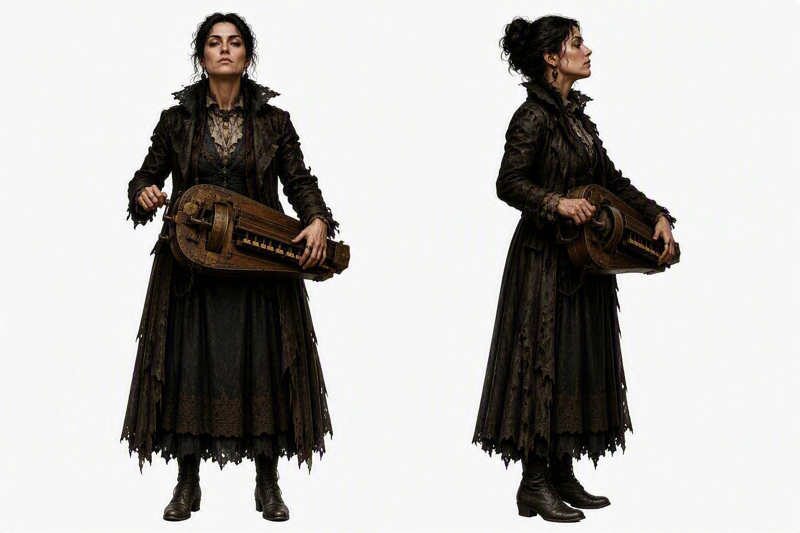
Her instrument is a hurdy-gurdy: a wheel cranked against strings, a keybox worn to the colour of tallow, four drones, and a buzzing bridge that wheel-players call the dog. Lean on the crank and the dog barks; that bark is her only percussion and she uses it like a drum. It is the instrument of her own country and she plays it like somebody who has never had to explain it.
She calls the instrument Kaspel, after the man who used to own it, and she talks to it constantly. It has never once answered. Her riding-beast answers all the time and she rarely listens.
Appearance
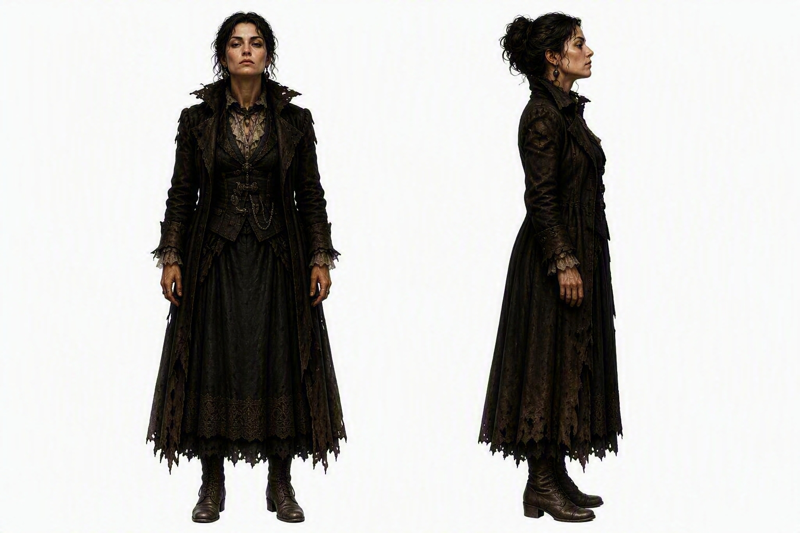
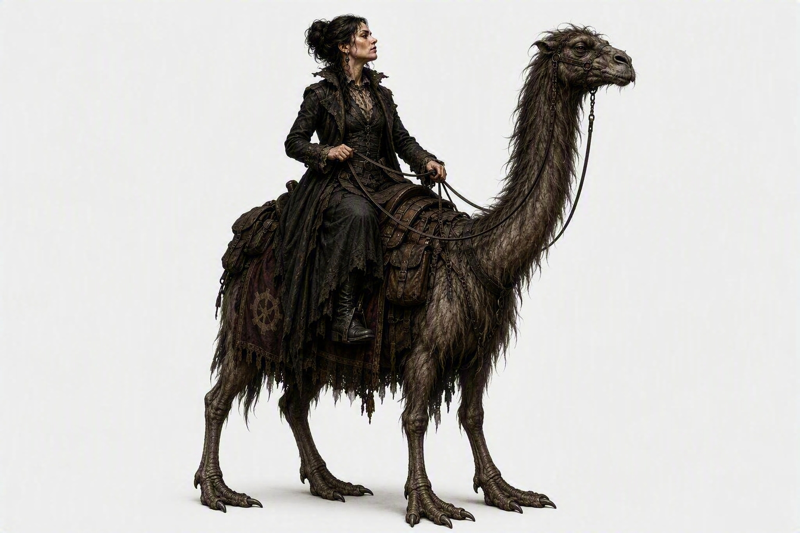
Broad, short, and solidly built, with heavy forearms from twenty years of crank and trap. Dark hair cut off at the jaw with a knife. A wide, mobile, cheerful face that has been broken across the nose at least once. She dresses in the wreckage of grandeur: a good coat, twice re-dyed, cuffed in a braid she stitched herself to resemble a livery that does not exist; boots repaired with wire; and a hat of no known fashion which she removes with tremendous ceremony before every performance.
In her left coat pocket she carries buttons — thirty or forty of them, none matching. Each was taken from the coat of somebody she could not help. They are not keepsakes and she is not sentimental about them; they are an accounting. She keeps them because she declines to pretend those people did not happen. If you ask, she will tell you the number and change the subject.
Early Life
Tibbet Snurl was born in Cutz to a family of rat-catchers, in a country of peat, black water, and enormous granaries whose grain nobody now remembers how to sell. The Snurls were good at their trade and low in the estimation of everyone else, which taught Tibbet two lessons early: that a person's worth is decided before they open their mouth, and that this decision can occasionally be overturned by singing.
She worked traps and terriers from the age of nine. She sang in the lofts because the work was filthy and the rats did not object.
At thirty-one she was engaged to clear the manse of the late thaumaturge Kaspel Voy, dead of an ill-advised rejuvenation and eleven months in his chair before anyone thought to look. The house was thick with vermin. It took her nine days. Voy's heirs, having quarrelled the estate down to fragments, declined to pay in coin and offered her instead a decayed hurdy-gurdy from a store-room, on the grounds that it was worth nothing and she seemed the sort to accept it.
She accepted it. She spent a winter learning the crank, a spring learning the keybox, and a summer learning that a drone does not stop merely because the singer needs to breathe. Then she burned her traps — kept one, for luck and for iron — and walked south out of Cutz under a new and much better name.
The Contract
Eight months ago, in a wet market town, Ossaline was approached by an agent of Zhevoun the Punctilious, a magnate of Almery who was assembling entertainment for his fourth nuptials. Zhevoun collects timbres. He had heard a description of her voice and wished to own the event of it.
The contract is four pages of exquisite penmanship. Its material terms are:
- a fee of three hundred terces, with forty paid in advance;
- performance of a programme of nine airs at the wedding feast, commencing at the appointed hour;
- and, in the event of late arrival, forfeiture of the voice itself, to be decanted at Zhevoun's convenience and added to his cabinet of Notable Timbres.
Ossaline signed it in front of witnesses, in a fine hand she had practised for years and never previously had cause to use. She has since read the fourth page more carefully.
Of the forty terces in advance, she has eleven. The remainder went, in order: to a widow, to a ferryman who did not ask for it, to a boy who wanted a knife, and to a man with an extremely detailed account of a lost sister who did not exist. She knew about the sister within a sentence and a half. She paid him anyway, on the grounds that a man who will construct that much architecture for four terces is a man who needs four terces.
She is aware of how this looks. She would do it again and probably will by Tuesday.
Sesquin
Her mount is Sesquin, an aged pacing-beast of the Cutz breed: long-necked, splay-footed, shaggy, swaybacked, and articulate. The breed's capacity for speech is a legacy of some vanished breeder's ambition, and in Sesquin's case the ambition appears to have stopped at vocabulary and never reached tact.
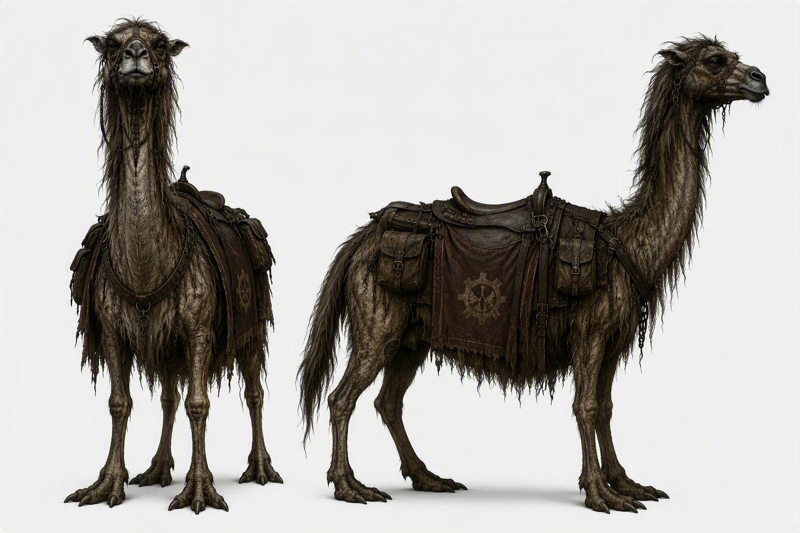
Sesquin claims descent from the beasts of the Sixteenth Aeon. He will not walk on wet stone. He regards Ossaline's repertoire as sentimental, her patter as excessive, and her business affairs as a slow-moving catastrophe he is contractually obliged to witness. He is right about all three. He has also, twice, stood over her while she slept in country where standing over her was dangerous, and neither of them has ever mentioned it.
They argue in front of audiences. It is the most popular part of the act, which infuriates them both.
The Sung Spells
Ossaline is not a magician. She is a singer who owns four spells, and the spells happen to be songs.
A sung spell works only when performed aloud, in full, in tune. It cannot be muttered, hinted, or hummed. And in the manner of all such workings, the performance consumes it: the moment the last note ends, the song is gone from her memory entirely. Not faded — gone. She cannot recall the tune, the words, or the fact that she ever knew it, except as an absence, like a tooth. Relearning takes three days with the vellum leaves of the Kaspel Folio and a great deal of swearing.
Her current holdings:
The Diminution of Ratteries — clears vermin from a building. A trade spell, inherited with the instrument. She has spent it more often than all the others together and has never once regretted it.
The Charitable Ear — the audience must hear the song to its end, and must judge it kindly. Ossaline maintains she keeps this one for emergencies. Sesquin maintains otherwise.
The Unbarring Chord — one closed thing opens. A door, a lock, a box, a mouth.
Threnn's Third Consolation — lifts grief from one living person, wholly and permanently. It is the most valuable thing she owns, worth more than the wedding fee, and she gives it away roughly once a year to whoever needs it in front of her at the time, usually before they have finished asking. Then she spends three days relearning it, so that she has it ready for the next one.
The ordinary songs — the road ballads, the tall tales, the boasts, the ones she actually makes her living on — hold no power at all and therefore never leave her. This strikes her as the joke at the centre of her profession: the songs worth keeping are the ones nobody would pay for, and the beautiful ones can only ever be heard once.
Character Traits
Ossaline expects the worst of people and is almost never wrong. She can price a room in a glance, spot a rehearsed hard-luck story before the second sentence, and tell you exactly which of the men buying her drinks intends to rob her. She has no illusions about the world, the Sun, her profession, her contract, or her own talent, and she will say so plainly if asked and often if not.
And she gives everything away regardless.
This is the whole of her, and it is important that it is not mistaken for softness. She is not sentimental. She does not weep at her own songs, she is not taken in, and she is not buying comfort. She simply does not believe that knowing a man is lying is a reason to let him go hungry. The knowledge and the kindness sit side by side and neither one interferes with the other. When she hands over money she cannot spare, she does it briskly, with a joke, and refuses to be thanked — because being thanked would imply she had a choice about it, and she has never felt that she did.
She lies constantly about her origins, her training, her honours, and the size of the rooms she has played, and never about anything that matters. She has never broken a promise made in a song, a distinction she considers legally sound and which has twice been upheld.
Her humour is dry, blunt and largely at her own expense. She is a coward in the ordinary way about weather, heights, water, and deodands, and completely without fear in front of a hostile crowd, which she regards as the one place in the world where she knows exactly what to do.
She believes — genuinely, and not as a piece of stagecraft — that the wheel must not stop. A hurdy-gurdy's drone is unbroken by design, and Ossaline has extended this into a private cosmology: a wheel that stops is a sun that stops. She will play through a bleeding hand rather than break a drone mid-tune. Under a Sun that has begun to stutter, this is either a superstition or a public service, and she is not interested in being told which.
Present Situation
She is somewhere on the long road south, with eleven terces, a beast who disapproves of her, a folio she reads too slowly, and a wedding at the end of it. The deadline is real, the penalty clause is real, and every league of the road contains somebody with a story she can see straight through and a need she will meet anyway.
She is, by any reasonable accounting, going to be late.
She is also assembling, stop by stop, the only body of work she will leave behind: an unreliable, self-flattering, largely true memoir in songs, sung in a low grainy voice over a wheel that never stops turning.
Story Use
Ossaline is the party's way in. She talks first, she is welcome in rooms where armed strangers are not, and she can gather more from an hour of playing to a taproom than a week of asking questions. She is useless in a straight fight and invaluable in a negotiation, a funeral, a crowd, or a standoff that has not quite started yet.
Her recurring conflict is simple and renewable: every act of kindness costs her something she cannot spare, and she sees the cost coming every time. The spell she gives away, the coin she hands over, the day she loses. She is not learning a lesson, because there is no lesson she does not already know. That is not a flaw to be cured over an arc; it is the engine.
Her central question is whether a song that can only be sung once is worth more than a song that lasts — and she has already answered it, expensively, several times.
Relationship to Other Characters
Where Ilyra Venn measures the world and records it exactly, Ossaline reads it just as accurately and then acts against her own findings. Ilyra distrusts her sources; Ossaline is an unreliable source and cheerfully admits it. Both are people who refuse to look away — one writes it down, the other pays for it. They would work well together and irritate each other permanently, which is the best possible footing for a duet.
Setting Notes
Draws on setting elements summarised in About The Dying Earth.md: the failing Sun, decayed civilisations, magic that vanishes from memory on casting, deodands and sandestins, terces as currency, and the overlap of forgotten machinery with living magic.
Canonical place-names used: Cutz (the cold north), Almery, Saponce, the river Scaum. The journey from Cutz to Almery deliberately mirrors Cugel's long walk home in The Eyes of the Overworld and Cugel's Saga — Ossaline is travelling the same road for a far sillier reason, and unlike Cugel she keeps arriving with less than she started with.
Ossaline Threnn, Tibbet Snurl, Kaspel Voy, Zhevoun the Punctilious, Sesquin, and the four sung spells are original inventions and appear nowhere in Vance.